
What makes the Broadcasting House unique is not just that it’s old and large, but also its structure. Think of it like a doughnut. The offices are located on the ring of the doughnut, with the broadcasting studios located in the inner ring. In other words, the office rooms protect the studios from noise and vibrations from outside.
Derek Robinson, who guided us around the BBC, was a gentleman.
The studios in this building are broadcasting (on-air) studios, and are not as large as recording studios, consisting of booths for announcers and DJs and a small monitor room. Broadcasting House is home to four on-air studios for BBC Radio 1 to 4.
Not only is it a large building, but it also houses the central control centre, which is the “command centre” of BBC radio. This centre is responsible for not only radio but also TV audio, making it the very nerve centre of the BBC. Of course, there is also a network room with local stations, which shows the importance of this building. In addition, at the base of the centre of the building, there is a building dating back to the early 1930s.
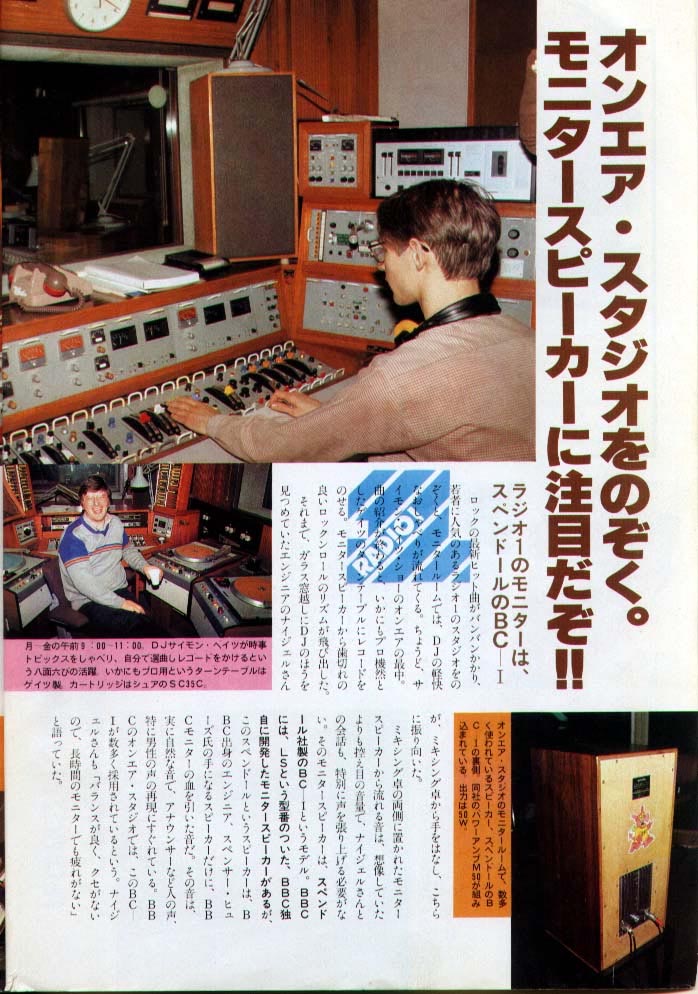
A look into the on-air studio. Pay attention to the monitor speakers!!!
Radio’s monitor is Spendor’s BC-I
The latest rock hits are playing, and in the monitor room of a radio studio popular with young people, a DJ plays lively tunes.
While the show was on air, he placed a record on the table in a truly professional manner, and a crisp rock and roll rhythm blared out from the monitor speakers.
Until then, Nigel, the engineer, had been watching the DJ through the glass window.
Mondays and Fridays, 9:00-11:00 AM. DJ Simon Heitz talks about current topics, selects his own music and plays records, and is a very active DJ. The turntable is made by Gates and the cartridge is a Shure SC35C.
The back of the Spendor BC-1 speaker, which is widely used in the monitor room of the on-air studio, is equipped with the company’s power amplifier M50.
It has a built-in output of 10W.
But then he took his hands off the mixing desk and turned to look at me.
The sound coming from the monitor speakers on both sides of the mixing desk was at a lower volume than I had imagined, and I didn’t have to raise my voice to talk to Nigel.
The model is the BC-I, manufactured by Spendor. The BBC has its own monitor speakers, designated LS, which it developed itself, but these Spendor speakers were designed by former BBC engineer Spencer Hughes, and so they have a sound that is a direct descendant of the BBC monitors. The sound is very natural, and they excel at reproducing human voices such as announcers, especially male voices. Apparently, many of these BC I speakers are used in the BBC on-air studios. Nigel commented, “They’re well-balanced and have no quirks, so you don’t get tired even after long periods of monitoring.”