
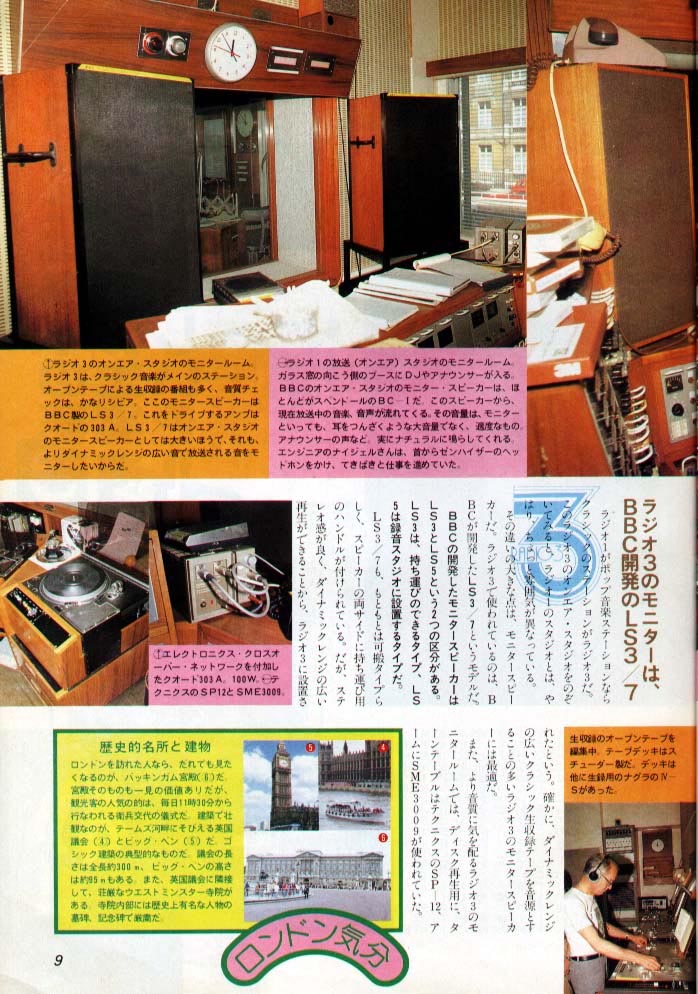
The monitor room in Radio 3’s on-air studio. Radio 3 is a station that primarily broadcasts classical music. Many of its programs are recorded live on open tape, so sound quality checks are quite strict. The monitor speakers here are BBC LS3/7s, driven by Quad 303 A amplifiers. The LS3/7s are on the larger side for on-air studio monitor speakers, as they are used to monitor the sound being broadcast with a wider dynamic range.
Quad 303A with electronic crossover network, 100W Technics SP12 and SME3009.
historical sights and buildings
Anyone who visits London wants to see Buckingham Palace (8). The palace itself is worth seeing, but the most popular attraction for tourists is the Changing of the Guard ceremony, which takes place every day at 11:30. The British Parliament (4) and Big Pen (5) towering over the Thames are spectacular examples of Gothic architecture. The Parliament is about 300 meters long, and the Big Pen is about 95 meters high. Adjacent to the British Parliament is the majestic Westminster Abbey, whose interior is solemn with tombs and memorials of famous historical figures.
Radio 1 broadcasts (on air) in the studio’s monitor room. The DJ and announcer sit in a booth on the other side of the glass window.
Most of the monitor speakers in the BBC’s on-air studios are Spendor BC-1s, from which the music and audio currently being broadcast is played. Although they are monitors, the volume is not ear-splittingly loud, but just right. The announcer’s voice sounds very natural.
Nigel, the engineer, was working efficiently with Sennheiser headphones around his neck.
Since it can play back, it is installed on Radio 3. It has a good stereo sound and a wide dynamic range. However, it is a portable type, and there are handles on both sides of the speaker.
The LS5 is a type that is installed in a recording studio. There are two types: the LS3 and the LS5. The monitor speakers developed by the BBC are the LS3, a portable type, and the LS5.
The room was equipped with an SME3009. The sound table was a Technics SP-2, and in the audio room, a tuner was used for disc playback.
The model used by Radio 3 is the LS3/7, developed by BC. The main difference is the monitor speaker.
It is said that the wide dynamic range of the monitor speakers of Radio 3, which often have a wide range of classical music, was used as the sound source.
The atmosphere is different. If you look at the radio studio, you will see that the classical music station is Radio 3. Radio 1 is a pop music station,
Radio 3 monitors are the LS3/7 developed by the BBC.
The tape deck used for editing the live recordings was a Studer, and there was also a Nagra N-S deck for live recording.