
David Reid, who gave us a tour of the design department
The BBC has four main sound departments:
There’s a gate.
Basic research and development will be carried out here.
Research Department
② Developed by the Design and Search Department
The BBC’s sound department is divided into four main divisions.
Just across the street from Broadcasting House is the BBC’s Design Department, which, although it’s called the Design Department, doesn’t decide on the shapes and colors, but rather is a department that researches broadcasting audio equipment such as monitor speakers, amplifiers, and turntables.
BBC monitor base
Apparently the idea is to faithfully reproduce the human voice!!!
This building houses the BBC’s radio and TV design department. It’s also an old building. It’s adjacent to Broadcasting House.
Equipment Department Procures necessary equipment and produces it in small quantities.
We will invest in equipment such as consoles.
Not only will we be replacing players for Broadcasting House’s Studio ④Capitol Project Mixing Geo, but we will also be replacing players for local stations around the country, so the number of players will be considerable. Moreover, we will be looking for products that are reliable and durable,
Among these four departments, the design department is
This department is very close to the point of contact between the audio field and audio equipment.
The speaker room where the monitor speakers used at BBC broadcast stations are brought in for adjustment.
It will be a careful and lengthy study.
The laboratory of the Design Department is
In the special section, surrounded by unfamiliar equipment and measuring instruments, engineers in white coats are hard at work.
Apparently, they are currently testing and researching a player system. After all, like Radio’s studio, Gates’ player is quite outdated, so they are in dire need of a new player.
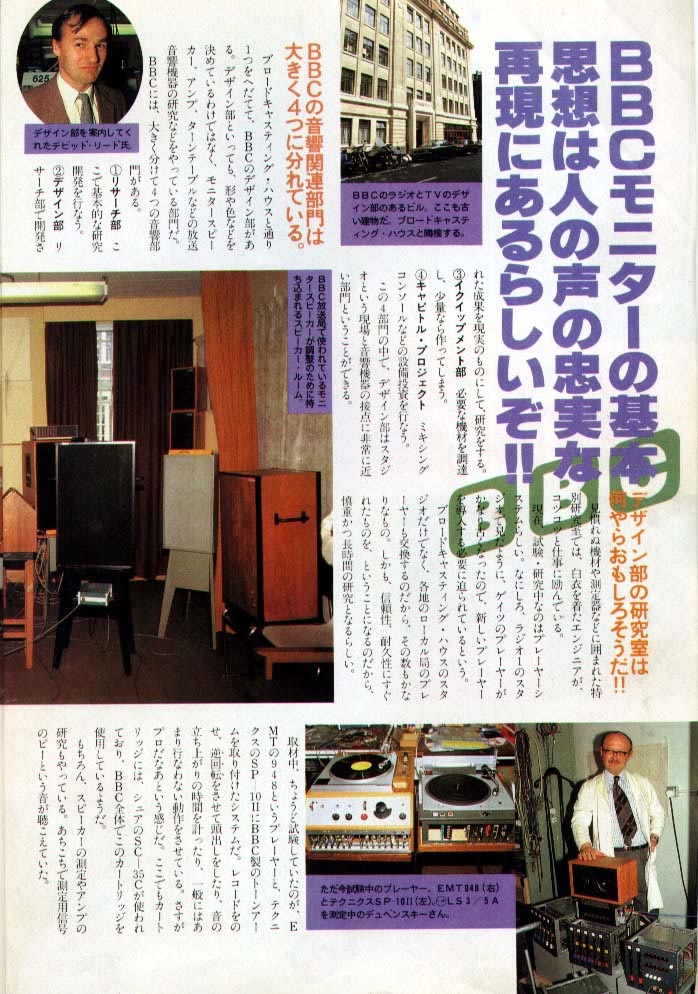
Dupenski is currently testing the EMT948 (right) and Technics SP-1011 (left) LS3/5A players.
During the interview, I was testing a player called EMT 948, a Technics SP-100 II, and a BBC tonearm.
It’s a system equipped with a record player. It can load a record, play it in reverse to find the beginning of the record, and measure the attack time of the sound, all of which are not commonly performed. It’s truly professional. Here too, the cartridge used is a Shure SC-5C, and it seems that this cartridge is used throughout the BBC.
Of course, they also conduct speaker measurements and amplifier research, and the beeping of measurement signals can be heard here and there.