
Let’s introduce three types of monitor speakers that are useful in recording studios!
A 15-minute drive northwest of BBC Broadcasting House, in a place called Maida Vale, there is a recording studio for BBC programs. The studio is not a modern building, but a nondescript single-storey building whose exterior is said to be the same as when it was built in the 1930s. Before that,
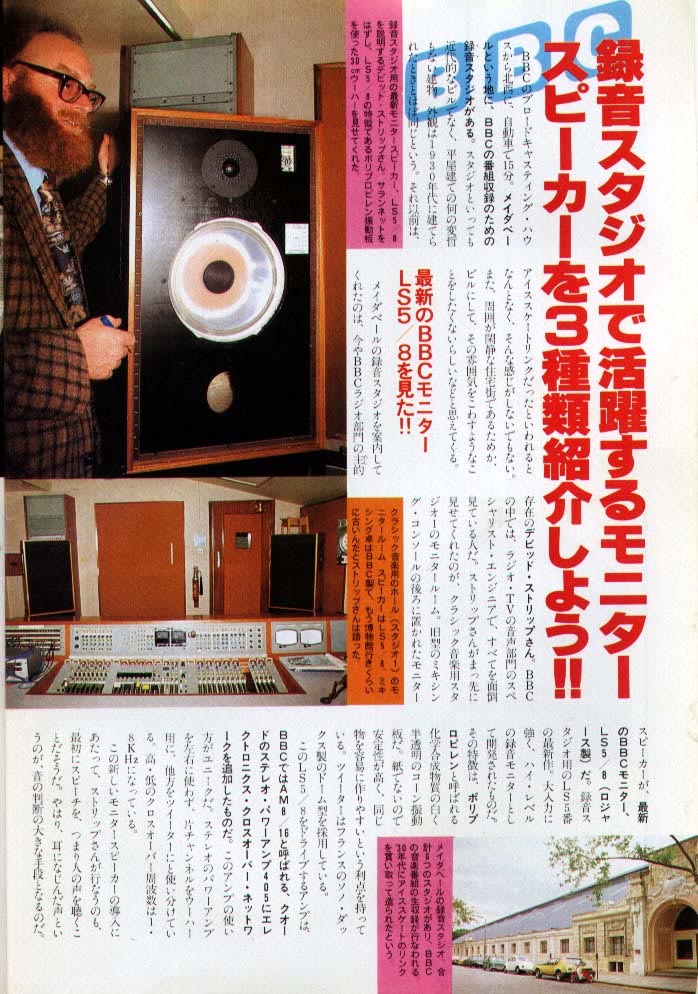
David Strip explains the LS5/1, the latest monitor speaker for recording studios. He removes the Tygan grille and shows us the 15″ woofer that uses a polypropylene diaphragm, a feature of the LS5/8.
When I hear that it used to be an ice skating rink, it does somehow feel that way. Also, perhaps because the surrounding area is a quiet residential area, it seems that they didn’t want to ruin the atmosphere by turning it into a building.
I saw the latest BBC monitor LS5/8!!!!
The man who showed me around the Maida Vale recording studios was now the head of the BBC radio division.
David Stripp, a BBC radio and TV sound specialist engineer, is the man in charge of everything. The first thing Stripp showed me was the monitor room in a classical music studio. The monitors were placed behind an old-fashioned mixing console.
The monitor room speakers in the classical music hall (studio) are LS5s. Strip said the mixing car was stolen from the BBC and is old enough to go to a museum.
The speakers are the latest LS5/8
It was developed as a recording monitor. Its distinctive feature is the white, translucent cone diaphragm made of polyp chemical synthetic material. Since it is not made of paper, it is highly stable and can be used with the same
It has the advantage of being easy to manufacture. The tweeter is a dome type made by the French company Audax.
The amplifier driving this LS5/8 is called the AM8/16 by the BBC, and is a quad stereo power amplifier 405 with an added electronics crossover network. The way this amplifier is used is unique. Instead of using stereo power amplifiers for the left and right, one channel is used for the woofer and the other for the tweeter. The high and low crossover frequency is -8K.
Maida Vale recording studio, where live recordings of music programs are made. In the 1910s, there were six studios, including an ice skating rink, and it was built after the BBC bought the studio.
When introducing these new monitor speakers, Strip says, “The first thing I do is listen to the speech, that is, the human voice. After all, a voice that is familiar to the ear is a major means of judging the sound.