
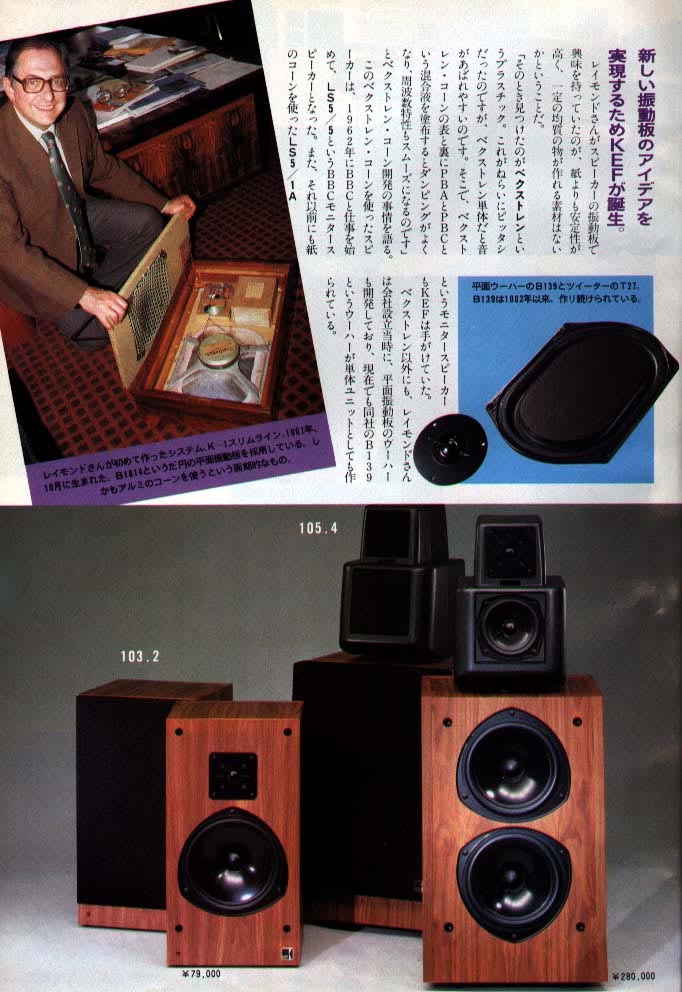
KEF was born to realize the idea of a new diaphragm.
What interested Raymond about speaker diaphragms was whether there was a material that was more stable than paper and could be used to create something of uniform quality.
“That’s when I discovered a plastic called Bextrene. It was exactly what I was looking for, but Bextrene alone tends to make the sound too wild. So, if you apply a mixture of PBA and PBC to the front and back of the Bextrene cone, the damping improves and the frequency characteristics become smoother,” he says, explaining the circumstances surrounding the development of the Bextrene cone.
This speaker using the Bextrene cone was developed into the BBC monitor speaker LS5/5 in 1962. Also, before that, the LS5/1A, which used a paper cone, was developed.
When the company was founded, it also developed a flat diaphragm woofer, and even today the company’s B139 woofer is still produced as a standalone unit.
The first system Raymond created was the K-1 Slimline. It was born in October 1951. It used an elliptical flat diaphragm called B1814. It was also revolutionary in that it used an aluminium cone.