
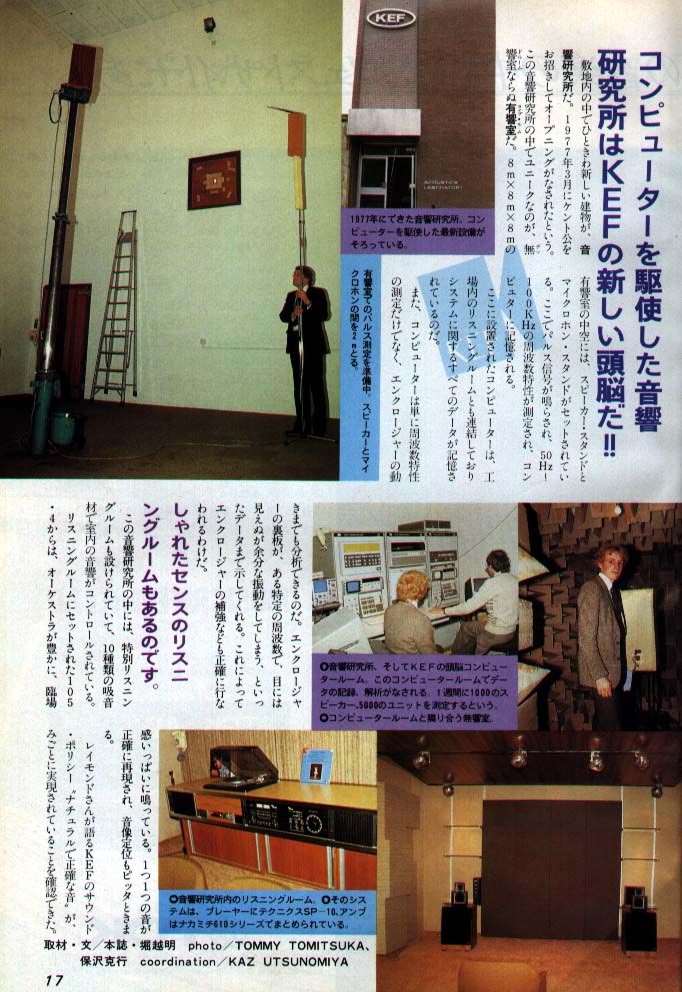
The Acoustics Research Laboratory was established in 1977 and is equipped with the latest computer-based equipment.
Preparing for pulse measurements in the reverberation room. 2 distance between microphones.
Speaker stands and microphone stands are set up in the hollow of the reverberation room. A pulse signal is generated here, and the frequency response of the 50/100K ratio is measured and stored in a computer.
The computer installed here is also connected to the listening room within the factory and stores all data related to the system.
In addition, the computer not only measures the frequency response, but also the movement of the enclosure.
It can even analyze the sound quality. It can even show data such as whether the back panel of the enclosure vibrates unseen at certain frequencies. This allows for accurate reinforcement of the enclosure.
There’s also a stylish listening room.
The acoustics laboratory also includes a special listening room, where the acoustics are controlled using 10 different types of sound-absorbing materials.
105 set up in the listening room
This is the acoustics laboratory and the KEF brain computer room, where data is recorded and analyzed. They measure 1,000 speakers and 5,000 units a week. Adjacent to the computer room is an anechoic chamber.
Each and every sound is accurately reproduced, and the sound image is perfectly positioned.
Raymond talks about KEF’s sound policy: “Natural and accurate sound,” and I was able to confirm that this has been beautifully realized.
The listening room in the acoustics research lab is equipped with a Technics SP-10 player and Nakamichi 610 series amplifiers.
Interview and text by this magazine and Akira Horikoshi. Photo by TOMMY TOMITSUKA.
Katsuyuki Hozawa coordination/KAZ UTSUNOMIYA