
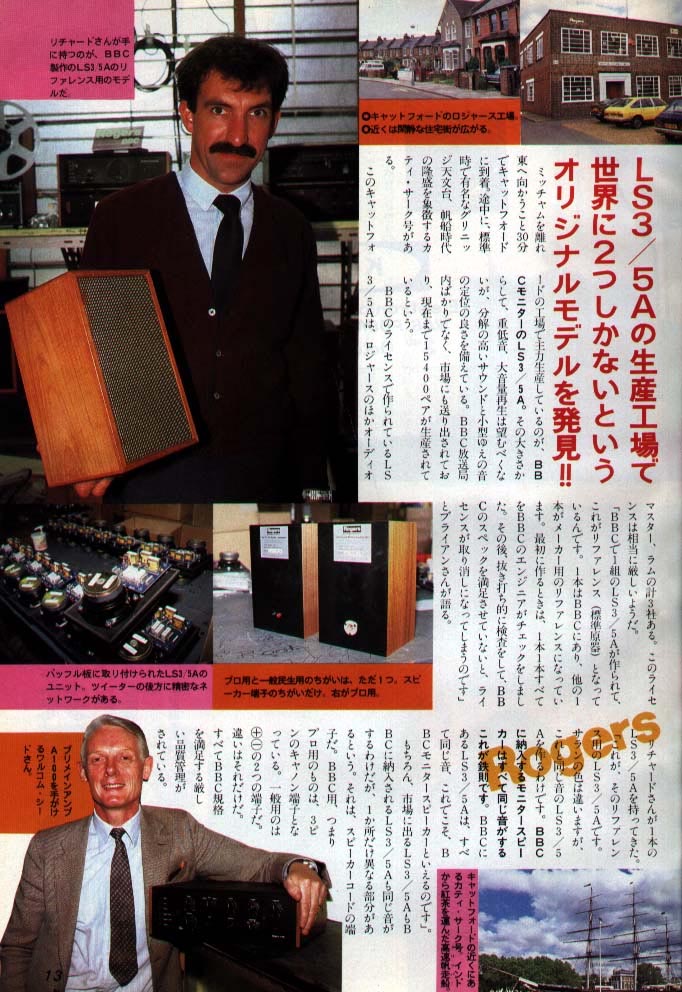
Richard is holding the reference model of the LS3/5A produced by the BBC.
The Rogers factory in Catford, surrounded by a quiet residential area.
Leaving Mitcham and heading east, we arrived at Catford in 30 minutes. On the way, we passed the Royal Observatory, famous for its standard time, and the Cutty Sark, a symbol of the glory of the Age of Sail.
The LS 3/5A, licensed by the BBC, is available from Rogers and other audio companies.
Discovered an original model of which there are only two in the world at the LS3/5A production factory!
The main product produced at the factory is the BBC monitor LS3/5A. Given its size, you can’t expect deep bass or high volume reproduction, but it has a high resolution sound and good sound localization due to its small size. It is not only used within BBC broadcasting stations but also in the market, and 15,400 pairs have been produced to date.
Brian says, “A pair of LS3/5A amplifiers were made at the BBC, and these served as the reference. One was kept at the BBC, and the other was used as a reference for manufacturers. When they were first made, each amplifier was checked one by one by a BBC engineer. After that, they were randomly inspected, and if they did not meet the BBC specifications, their license would be revoked.”
There are three companies in total.
Richard brought an LS3/5A.
The LS3/5A unit is mounted on the baffle board. There is a precision network behind the tweeter.
The only difference between professional and consumer models is the speaker terminals. The one on the right is for professional use.
“This is the reference LS3/5A. Although the colour of the Tygan is different, we are making an LS3/5A that sounds the same. It is a golden rule that all monitor speakers delivered to the BBC have the same sound. All LS3/5As at the BBC sound the same, and this is what makes them BBC monitor speakers.”
Of course, the LS3/5A delivered to BBC will have the same sound as the LS3/5A that will be released on the market, but there is one difference. That is the speaker cord terminal. The BBC version, that is, the professional version, has a 3-pin Canon terminal. The general version has two terminals, + and -. That is the only difference. All are subject to strict quality control to meet BBC standards.